AI Should Augment Human Intelligence, Not Replace It
AI is evolving fast — but are we using it to enhance human thinking, or replacing our ability to think? A case for keeping humans intellectually active in an AI-powered world.
# AI Should Augment Human Intelligence, Not Replace It
Artificial Intelligence is evolving rapidly. Every day we see new tools capable of writing code, generating videos, solving mathematical problems, designing systems, and even making strategic decisions. While this progress is exciting, it also raises an important question:
Are we using AI to enhance human intelligence, or are we slowly replacing our own ability to think?
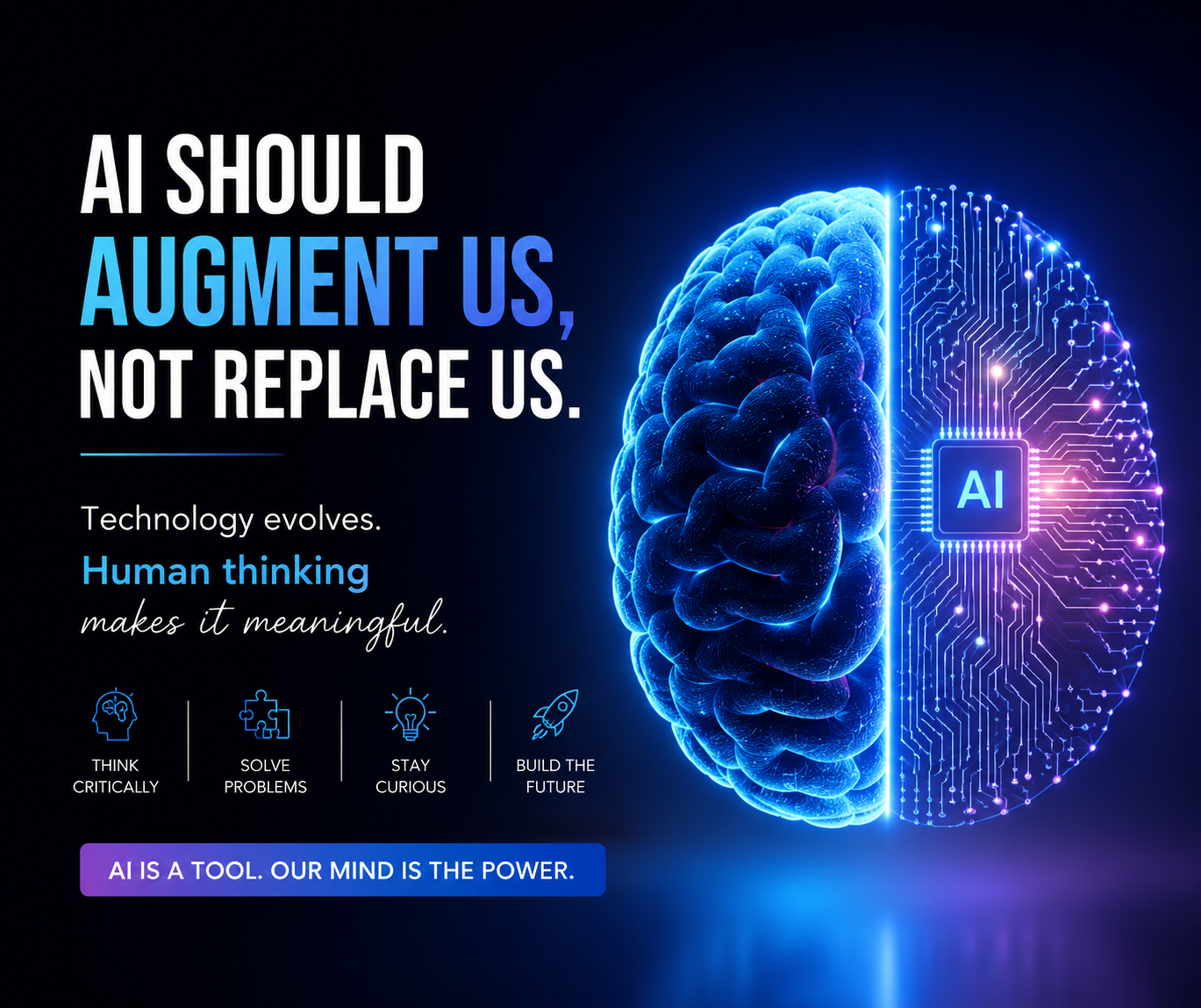
I strongly believe AI should be an augmenter of human capability, not a replacement for human thinking.
Our brains remain healthy through exercise — not physical exercise alone, but mental exercise as well. Just like muscles become weak when they are not used, the brain becomes dull and lazy when we stop solving problems ourselves. Regardless of our profession, we should continuously challenge ourselves to think critically, analyze situations, and solve problems independently.
AI can accelerate work, automate repetitive tasks, and reduce time-to-market dramatically. It can help developers write boilerplate code, assist designers with ideation, and help researchers process enormous amounts of information. These are powerful advantages. However, blindly relying on AI to solve every problem for us is dangerous.
If future generations stop practicing problem solving because “AI can do it,” we risk creating a society with weaker analytical thinking and reduced creativity. Students may no longer feel the need to struggle through difficult concepts. Universities may produce graduates who know how to prompt AI systems but lack deep understanding of their own field.
The danger is not AI itself.
The danger is becoming intellectually dependent on it.
The Importance of Critical Thinking
Critical thinking is not built by consuming answers. It is built through struggle, experimentation, mistakes, and reflection. The process of solving a difficult problem activates the brain in ways passive learning never can.
This realization became very clear to me recently while revising some fundamental concepts in system design — specifically, software design patterns.
Traditionally, design patterns are often taught as theoretical concepts. Developers memorize definitions like Factory Pattern, Observer Pattern, Strategy Pattern, or Singleton Pattern. The problem is that theoretical memorization fades quickly because the brain does not strongly connect the concepts to practical situations.
Instead of simply asking AI to explain design patterns, I decided to use AI differently.
I asked Claude Code to act as a learning partner rather than a solution machine.
Instead of giving me direct explanations, I asked it to create real-world scenarios and challenge me with questions like:
- “Which design pattern would best solve this problem?”
- “Why would one approach be better than another?”
- “What trade-offs exist in this architecture?”
This changed the entire learning experience.
Rather than passively consuming information, I was actively thinking. My brain had to analyze the problem, evaluate multiple approaches, and justify decisions. AI became a mentor that accelerated my learning process instead of replacing my thinking process.
That distinction is extremely important.
AI as a Cognitive Partner
The best use of AI is not outsourcing intelligence entirely. The best use of AI is amplifying human intelligence.
AI should:
- Reduce repetitive work
- Speed up execution
- Help brainstorm ideas
- Simulate scenarios
- Assist in learning
- Provide faster access to information
- Act as a collaborative thinking partner
But humans should still:
- Think critically
- Solve problems
- Make architectural decisions
- Understand foundational concepts
- Build intuition through practice
- Question assumptions
- Develop creativity and reasoning skills
The future will likely belong not to people who simply use AI, but to people who can think deeply with AI.
The Responsibility Ahead
We are entering a time where convenience is becoming dangerously easy. It is tempting to let AI handle everything — from writing and coding to decision-making and learning. But convenience should not come at the cost of cognitive decline.
As professionals, educators, parents, and students, we should consciously preserve our problem-solving abilities. We should use AI to enhance our productivity while continuing to challenge our minds.
Because once humans stop thinking deeply, rebuilding those abilities will become much harder than automating them.
AI is one of the most powerful tools humanity has ever created.
But the goal should never be to replace human intelligence.
The goal should be to elevate it.
Software Architect
Mudassar Majeed is a Software Architect at Originsoft Consultancy with over a decade of experience designing distributed systems, microservices architectures, and cloud-native platforms. He has led architecture reviews and technical transformations across multiple enterprise systems, with deep expertise in system design, scalability, and long-term technical strategy.
Related Articles
From Tools to Systems: AI Business Models That Scale in 2026
Agents as a Service (AaaS) is poised to replace SaaS and create a new generation of millionaires. Learn what AaaS is, why it matters, and how to build your own AI agent business.
The Shape of Fairness: Why the World Should Look More Like a Narrow Bell Curve
A statistics-flavored argument for bounded inequality: why extreme wealth outliers signal an unstable system, and why a narrower distribution can mean a healthier society.