
Building Production-Ready AI Agents: A Complete Architecture Guide
In 2026, the gap between AI demos and real tools is defined by agency. This guide explains how to architect, orchestrate, and operate AI agents that can be trusted in production.
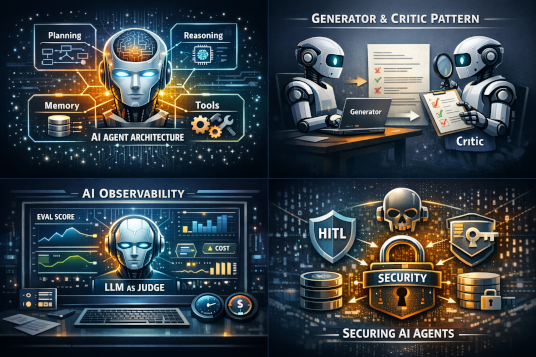
Introduction
In 2026, the difference between an AI "toy" and a production "tool" is agency. We have moved beyond simple chatbots that wait for a prompt and respond with text. Modern systems are expected to plan, reason, and execute actions across enterprise environments with minimal supervision.
This shift has exposed a hard truth: without a robust architecture, AI agents quickly become unpredictable, expensive, and insecure. Production readiness is no longer about prompt quality—it is about system design. This guide outlines the architectural blueprint required to build AI agents that can operate reliably in the real world.
From Chatbots to Agents with Agency
Early AI systems were reactive. A user asked a question, the model responded, and the interaction ended. Production agents are fundamentally different. They must:
Treating these agents as “smarter chatbots” is one of the fastest paths to production failure.
The Cognitive Architecture: The Brain of the Agent
A production-ready agent is not a single model invocation. It is a composed system with clearly defined cognitive responsibilities. In practice, most successful systems separate the agent into four core components:
Clear separation between these components makes agent behavior understandable and controllable.
Planning: Removing Guesswork from Autonomy
In production, you cannot leave planning to chance. Agents must explicitly reason about what to do next, not improvise endlessly.
Two planning strategies dominate production systems:
Unbounded dynamic planning often leads to looping behavior and cost explosions if not carefully constrained.
Reasoning with Constraints
Reasoning engines should be goal-oriented rather than conversational. Production agents work best when they:
This makes agent decisions explainable and auditable—both essential for enterprise trust.
Memory Systems: Context Without Chaos
Memory is one of the most misunderstood aspects of agent design. More memory does not mean better behavior.
Production agents typically require two distinct memory types:
Blending these layers without discipline leads to noisy prompts, hallucinations, and unpredictable costs.
Memory Lifecycle Management
Not all memory deserves permanence. Production systems must:
Memory should be treated as a managed resource, not a dumping ground.
Core Orchestration Patterns
Autonomy without structure is chaos. By 2026, most teams have moved away from black-box agents toward deterministic orchestration patterns.
Sequential and Parallel Execution
Explicit orchestration improves throughput and simplifies debugging.
The Generator–Critic Pattern
For high-stakes outputs, a single agent is rarely sufficient. The Generator–Critic pattern has become the standard:
A hard iteration limit is essential to prevent infinite refinement loops.
Choosing the Right Framework (Pragmatically)
Framework choice should follow architecture, not lead it. The key question is not “Which framework is best?” but “How much autonomy do we actually need?”
High-control systems benefit from graph-based or stateful orchestration. More exploratory systems may tolerate conversational agent frameworks. Overengineering autonomy early often slows teams down rather than accelerating delivery.
Tooling and the Model Context Protocol (MCP)
As agents gained access to real systems, tooling became a security boundary. In 2026, the Model Context Protocol (MCP) has emerged as the standard for connecting agents to tools safely.
MCP enables:
This shifts tool access from ad-hoc integration to governed infrastructure.
Observability and LLM-as-a-Judge
Traditional logs are insufficient for non-deterministic systems. Production agents require deep observability.
Effective stacks include:
If a $0.50 agent run does not deliver $0.50 of value, it is not production-ready.
Security: Defending Against Agency Abuse
As autonomy increases, agents become a new kind of insider threat. Production systems must defend against:
The principle of least privilege is non-negotiable. Agents should only have the minimum access required to complete their task.
Human-in-the-Loop and Compliance
For high-risk actions—sending emails, modifying records, spending money—human approval remains essential. Human-in-the-loop controls are not a weakness; they are a trust mechanism.
Regulatory frameworks increasingly require auditability, explainability, and override mechanisms. Systems that ignore these requirements rarely survive real deployment.
Conclusion: From Prompt Engineering to System Engineering
Building production-ready AI agents is a shift from prompt engineering to system engineering. Intelligence alone is not enough. Reliability, cost control, observability, and security define success.
Teams that modularize cognition, enforce structured orchestration, and treat autonomy as a managed capability move beyond chatboxes—and build agents that can be trusted as real enterprise workers.
Engineering Team
The engineering team at Originsoft Consultancy brings together decades of combined experience in software architecture, AI/ML, and cloud-native development. We are passionate about sharing knowledge and helping developers build better software.
Related Articles
Building Intelligent Swarm Agents with Python: A Dive into Multi-Agent Systems
Swarm agents and multi-agent systems let specialized agents collaborate to solve complex workflows. This article walks through a Python implementation and explores why MAS matter.
Unlocking the Power of CrewAI: A Comprehensive Guide to Building AI-Driven Workflows
A practical guide to building multi-agent workflows with CrewAI—how agents, tasks, crews, and tools fit together, plus six real scenarios like job search automation, lead generation, and trend analysis.
The Death of Prompt Engineering: Why Flow Engineering Is the New AI Frontier
Prompt engineering is no longer enough. Learn why flow engineering and agentic workflows now define how reliable, scalable AI systems are built.