
Building Production-Ready AI Agents: A Complete Architecture Guide
In 2026, the gap between AI demos and real tools is defined by agency. This guide explains how to architect, orchestrate, and operate AI agents that can be trusted in production.
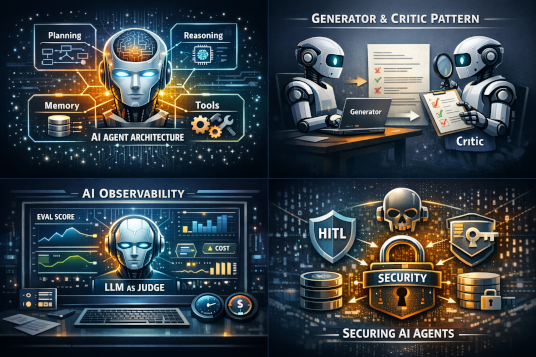
In 2026, the line separating an AI toy from a production-grade tool is no longer intelligence — it is agency. The market is saturated with models capable of generating fluent text, summarizing documents, writing code, and answering questions. Yet fluency alone does not make a system trustworthy. The defining feature of modern AI systems is no longer their ability to respond, but their ability to act. Production environments now expect agents to plan multi-step workflows, reason across constraints, invoke external systems, manage memory, and execute decisions with minimal supervision. This shift has revealed a fundamental truth that many teams discover too late: without disciplined architecture, autonomy becomes chaos.
The early wave of AI applications treated large language models as conversational interfaces. A prompt was submitted, a response was generated, and the interaction concluded. These systems were reactive and contained. Their failure modes were mostly limited to incorrect answers or awkward phrasing. But as organizations began embedding agents into enterprise workflows — granting them access to databases, APIs, messaging systems, and financial operations — the stakes changed dramatically. An agent that can write an email is harmless. An agent that can send thousands of emails, modify records, or execute financial transactions is an entirely different category of system. In this context, production readiness ceases to be about prompt cleverness and becomes a matter of structural control.
Treating agents as "smarter chatbots" is one of the fastest paths to production failure. Chatbots respond; agents decide. Chatbots generate; agents execute. The moment execution enters the equation, architecture becomes non-negotiable. Agency introduces unpredictability, cost variability, and security exposure. Without explicit planning boundaries, agents can loop indefinitely. Without memory discipline, they accumulate noise and hallucinate context. Without access control, they become vectors of internal threat. Production AI is not about intelligence amplification — it is about risk containment through system design.
Cognitive Architecture: Separating Concerns
At the heart of a production-ready agent lies a cognitive architecture that mirrors disciplined organizational structure. A robust agent is not a single model invocation wrapped in a loop. It is a composed system in which cognitive responsibilities are separated into distinct layers. Successful implementations typically partition the agent into at least four core components: a planner that determines the next step toward a goal, a reasoning engine that evaluates constraints and generates structured decisions, a memory system that manages context across time, and an execution layer that interfaces with external tools. This separation is not cosmetic. It makes behavior inspectable. It makes failures diagnosable. It transforms a black-box model into a structured decision engine.
Planning, in particular, represents the difference between improvisation and controlled autonomy. In non-production prototypes, agents often "figure things out" dynamically as they go, generating step-by-step thoughts without predefined structure. In real environments, such improvisation is unacceptable. Planning must be explicit. The agent must articulate what it intends to do before doing it. Two dominant strategies have emerged. The first is structured static planning, where workflows are predefined and agents select from constrained paths. The second is bounded dynamic planning, where agents generate plans on the fly but within strict limits — iteration caps, cost ceilings, and state transition rules. Unbounded planning leads to infinite loops, runaway token consumption, and unpredictable behavior. Autonomy must be constrained by design.
Reasoning in production systems must also be goal-oriented rather than conversational. An enterprise agent does not need to produce eloquent explanations unless explicitly requested. Its reasoning should be optimized for clarity, traceability, and constraint satisfaction. Effective agents generate structured intermediate outputs: decision trees, action lists, or schema-bound results. This structure makes decisions auditable. When an agent modifies a database entry or escalates a workflow, stakeholders must be able to trace how that decision was made. Conversational reasoning is persuasive; structured reasoning is defensible. Enterprises demand the latter.
Memory Design and Lifecycle Management
Memory design is another domain where architectural discipline separates production tools from experimental prototypes. It is tempting to assume that more context produces better decisions. In reality, unmanaged memory often degrades performance. Production agents typically require two distinct memory layers: short-term operational memory that maintains immediate conversational or task context, and long-term knowledge memory that stores validated, persistent information. Blending these layers indiscriminately introduces noise, increases token costs, and amplifies hallucination risk. Memory should be curated, summarized, and pruned systematically. It is not a dumping ground for raw transcripts.
Memory lifecycle management becomes essential as systems scale. Not all data deserves permanence. Production systems must enforce retention policies, summarize historical context into structured representations, and discard irrelevant artifacts. Stale memory can bias future decisions in unintended ways. Furthermore, uncontrolled memory growth directly impacts cost, since token-based inference scales with context size. Effective systems treat memory as a managed resource, subject to compression, expiration, and auditing — much like any other enterprise asset.
A key pattern that has emerged in 2026 is the separation of episodic memory from semantic memory. Episodic memory records what happened — the specific sequence of actions, tool calls, and outcomes within a session. Semantic memory records what was learned — generalizations, facts, and policies derived from many sessions. Episodic memory is volatile; it supports session-level reasoning and is typically discarded after a workflow completes. Semantic memory is durable; it informs future sessions with accumulated knowledge. Systems that conflate the two tend to either forget too quickly or accumulate noise indefinitely. The architectures that perform best in production treat memory as a pipeline, not a pile.
Orchestration Patterns for Reliable Execution
As autonomy increases, orchestration patterns become the scaffolding that prevents chaos. Early agent systems often relied on black-box loops in which the model repeatedly evaluated its own output. By 2026, mature teams have shifted toward deterministic orchestration graphs. Sequential execution patterns ensure that steps occur in controlled order. Parallel execution patterns enable independent subtasks to run concurrently when safe. Explicit orchestration makes debugging tractable. When failures occur, teams can identify which node in the workflow malfunctioned rather than diagnosing an opaque reasoning chain.
One orchestration pattern has become especially prominent in high-stakes applications: the Generator–Critic model. In this pattern, one agent generates a proposed output while another independently evaluates it against constraints or quality standards. The critic does not attempt to improve the output indefinitely; it either approves, rejects, or requests bounded refinement. A hard iteration limit prevents infinite refinement loops that inflate cost and delay execution. This pattern mirrors human workflows in legal review, software code review, and editorial processes. It introduces redundancy for reliability without sacrificing autonomy.
Framework selection, meanwhile, must follow architectural intent rather than trend. The question is not which orchestration library is most popular but how much autonomy is appropriate for the use case. Highly regulated environments benefit from graph-based systems that enforce explicit state transitions. Experimental research workflows may tolerate more conversational autonomy. Overengineering autonomy early in development often slows teams down and obscures accountability. Autonomy should be introduced progressively, not assumed by default.
Tool Integration and the MCP Standard
Tool integration has emerged as both a capability multiplier and a security boundary. As agents gained the ability to access databases, send emails, execute code, and manipulate financial systems, governance frameworks became indispensable. The Model Context Protocol (MCP) has emerged as a structured method for connecting agents to tools through well-defined contracts. Rather than allowing ad-hoc API calls embedded in prompt instructions, MCP formalizes tool invocation with typed schemas, authentication controls, and permission layers. This shifts tool access from improvised integration to governed infrastructure.
The agent does not merely know that a tool exists; it interacts through a controlled interface that enforces scope and validation. Every tool invocation is logged, traceable, and auditable. This matters enormously in environments where agents interact with sensitive systems. A tool that can query a database should not be able to modify it unless explicitly granted write access. A tool that can send a message should not be able to access internal financial records. MCP enforces these boundaries at the protocol level, not at the prompt level, which means they cannot be bypassed by a cleverly crafted instruction.
Beyond MCP, effective production teams build tool registries — catalogs of available capabilities with documented inputs, outputs, and failure modes. Agents query the registry to discover what tools are available rather than having tools hard-coded into the system. This makes tool ecosystems maintainable and extensible. Adding a new capability is a matter of registering a tool and defining its schema, not modifying agent logic. Removing a deprecated tool is equally clean. The registry pattern brings the discipline of API versioning and service contracts into the world of AI tooling.
Observability and Cost Management
Observability is another pillar of production readiness. Traditional logging is insufficient for non-deterministic systems. Because LLM outputs vary across runs, monitoring must capture not only execution traces but also qualitative evaluation. Effective production stacks include cost tracking per agent run, latency monitoring across steps, structured logs of intermediate reasoning states, and evaluation systems often described as "LLM-as-a-Judge," where separate models assess output quality against defined metrics.
Production readiness requires value alignment: if a $0.50 run does not produce $0.50 worth of measurable utility, the architecture must be reconsidered. Cost transparency is not optional. Teams that cannot attribute token consumption to specific workflows cannot optimize intelligently. Dashboards that surface cost per workflow, per tool invocation, and per iteration cycle are as important as latency monitors. In enterprise environments, AI inference costs can scale faster than engineering teams anticipate. Governance of compute spend is a necessary counterpart to governance of agent behavior.
Latency monitoring deserves particular attention in multi-step workflows. A single LLM call might complete in two seconds. A ten-step agent workflow with sequential tool calls and iterative reasoning might take three minutes. Users who experience this latency without feedback become frustrated. Production systems must surface progress indicators, intermediate results, and estimated completion times where possible. Long-running agents benefit from streaming outputs, checkpoint resumption, and explicit human hand-off points when execution exceeds a time budget.
Security, Trust, and Human Oversight
Security, perhaps more than any other domain, redefines what it means to deploy agents responsibly. As agents acquire execution authority, they become a new class of insider actor. Prompt injection attacks, tool misuse, privilege escalation, and data exfiltration risks must be anticipated. The principle of least privilege becomes mandatory. Agents should have only the minimum permissions necessary to complete their assigned task. Network segmentation, credential isolation, and runtime monitoring are no longer concerns reserved for traditional backend systems; they are central to agent deployment.
Prompt injection represents a particularly insidious threat. Unlike traditional injection attacks that exploit parsing vulnerabilities, prompt injection exploits the semantic flexibility of language models. A malicious instruction embedded in retrieved content, a tool response, or even a user message can redirect an agent's behavior in ways that bypass intended constraints. Production systems must sanitize inputs from external sources, enforce output validation, and log all tool invocations for forensic review. Defense cannot rely on prompt-level guardrails alone; it must be built into the architecture.
Human-in-the-loop mechanisms remain essential, particularly for high-risk operations. An agent may draft a financial transaction, but approval may require human confirmation. An agent may propose record modifications, but final execution may require supervisory review. These safeguards are not signs of weakness; they are trust mechanisms. Regulatory landscapes increasingly demand explainability, audit trails, and override capabilities. Systems that ignore compliance realities rarely survive real-world deployment. The degree of human oversight should be proportional to the potential impact of a mistake.
From Prompt Engineering to System Engineering
The transition from prompt engineering to system engineering marks a maturation of the field. Early experimentation focused on crafting better instructions to coax superior responses. Production deployment demands far more: modular cognition, bounded autonomy, cost discipline, observability infrastructure, security enforcement, and governance frameworks. Intelligence remains necessary, but it is insufficient on its own. Reliability defines trust. Architecture defines reliability.
The teams that succeed in this new era are not those who build the most autonomous agents first. They are the teams who treat autonomy as a managed capability — introduced carefully, measured rigorously, and constrained deliberately. They modularize cognition, separate planning from execution, treat memory as infrastructure, enforce orchestration patterns, and embed security at every layer. In doing so, they move beyond chat interfaces and into a new category of enterprise worker: agents that are not only intelligent, but dependable.
The practical implication for engineering teams is clear: invest in architecture before autonomy. Define the cognitive boundaries of your agent before expanding its permissions. Build observability before scale. Establish trust mechanisms before removing human checkpoints. Each of these investments pays compounding returns as the system grows in capability and responsibility.
And in production systems, dependability is the only intelligence that matters.
AI Engineer
Azeem Azhar is an AI Engineer at Originsoft Consultancy specializing in agentic AI systems, large language model orchestration, and production AI deployment. He has built and shipped multi-agent workflows across a range of enterprise use cases, from intelligent automation to decision-support systems.
Related Articles
Building Intelligent Swarm Agents with Python: A Dive into Multi-Agent Systems
Swarm agents and multi-agent systems let specialized agents collaborate to solve complex workflows. This article walks through a Python implementation and explores why MAS matter.
Unlocking the Power of CrewAI: A Comprehensive Guide to Building AI-Driven Workflows
A practical guide to building multi-agent workflows with CrewAI—how agents, tasks, crews, and tools fit together, plus six real scenarios like job search automation, lead generation, and trend analysis.
The Death of Prompt Engineering: Why Flow Engineering Is the New AI Frontier
Prompt engineering is no longer enough. Learn why flow engineering and agentic workflows now define how reliable, scalable AI systems are built.