
Kubernetes Cost Optimization: A Practical Guide
Running Kubernetes at scale can be expensive. Learn practical strategies to optimize costs without sacrificing performance or reliability.
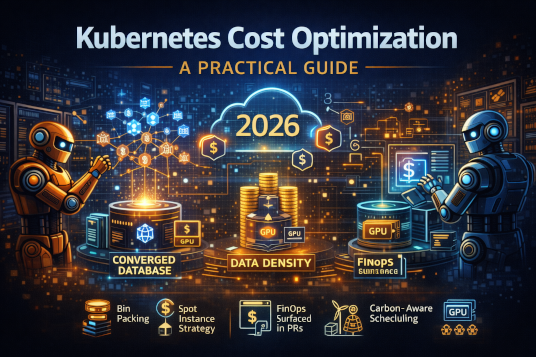
Running Kubernetes at scale can be expensive. Learn practical strategies to optimize costs without sacrificing performance or reliability.
In the early 2020s, we talked about Kubernetes as the "operating system of the cloud." By 2026, it has become something more akin to a utility—ubiquitous, essential, and, if unmanaged, incredibly expensive. The "Kubernetes Tax" is no longer just the overhead of the control plane; it is the massive amount of "slack" or unutilized resources sitting in your clusters because of defensive engineering.
In real production systems, your cloud bill is a high-latency proxy for your architectural maturity. Most teams are not overspending because they have too much traffic; they are overspending because they are using 2018-era scaling strategies for 2026-era workloads. This guide moves past the basic "right-sizing" tips to explore the intersection of autonomous provisioning, agentic workload management, and the emerging field of carbon-aware scheduling.
1. The Request/Limit Paradox: Why Safety is Expensive
The most common source of waste is the fundamental misunderstanding of how Kubernetes handles resources. We’ve been told for years to set "Requests" and "Limits" for every container. In practice, this often leads to clusters that are 80% "allocated" but only 10% "utilized."
The CPU Throttling Trap
Teams often discover this the hard way: setting strict CPU limits can actually degrade performance. In 2026, the consensus among senior platform engineers has shifted. While Memory Limits remain mandatory (to prevent a single leaky pod from crashing a node), CPU Limits are increasingly viewed as a bottleneck for latency-sensitive services.
The Reality: When you set a CPU limit, the Linux CFS (Completely Fair Scheduler) throttles your process if it exceeds its quota within a 100ms window. This creates "micro-stutters" that kill p99 latency.
The Strategy: Set a realistic CPU Request based on p90 usage, but consider removing the limit entirely or setting it significantly higher (3x–5x) than the request. This allows pods to "burst" into the idle slack of the node without being penalized.
Memory: The Non-Negotiable Boundary
Unlike CPU, memory cannot be throttled. If you exceed your limit, the OOM (Out Of Memory) killer steps in.
Common Mistake: Setting requests and limits to be identical. This creates a "Guaranteed" Quality of Service (QoS) class, which is great for predictability but terrible for cost.
Better Approach: Use the Vertical Pod Autoscaler (VPA) in "Recommendation Mode" during your staging cycles to find the "Goldilocks" zone, then apply those values via your GitOps pipeline.
2. From Reactive Autoscaling to Just-in-Time Provisioning
If you are still using the standard Cluster Autoscaler (CA) and fixed-size node groups, you are paying for infrastructure you don't need.
The Karpenter Revolution
By 2026, Karpenter has effectively replaced CA for high-performance teams. The difference is architectural: CA tries to find a node group that could fit a pod; Karpenter looks at the pod's requirements and talks directly to the cloud provider's API to provision the exact right instance.
Heterogeneous Node Pools: In a real-world cluster, you don't want twenty m5.large instances. You want a mix of small, large, compute-optimized, and memory-optimized nodes.
Bin Packing: Karpenter excels at "compacting" workloads. It will proactively move pods to consolidate them onto fewer nodes, allowing it to terminate expensive, underutilized instances.
3. The Spot Instance Gamble: Beyond the 90% Discount
We all know Spot (or Preemptible) instances are cheap. But at 2026 scale, the "interruption" isn't just a nuisance; it’s a systematic risk, especially with the rise of stateful workloads in Kubernetes.
Orchestrating for Interruption
This works well at small scale, but breaks when you have 1,000 pods all trying to reschedule simultaneously during a mass Spot reclamation event.
Node Termination Handlers: You must use an automated handler that catches the "termination notice" (usually 2 minutes) and proactively cordons/drains the node.
Mixed-Strategy Provisioning: Never go 100% Spot for a production service. A healthy ratio for 2026 is 30% On-Demand / 70% Spot. This ensures that even in a "Spot Drought," your service maintains a base level of availability while the autoscaler hunts for new capacity.
4. Scaling for the Agentic Era: AI and GPU Costs
The fastest-growing segment of Kubernetes spend in 2026 is GPU infrastructure for AI agents and LLM inference. These workloads are "bursty" and expensive.
GPU Multi-Tenancy (MIG and Time-Slicing)
If you assign a full A100 or H100 GPU to a single inference pod, you are likely wasting 80% of that hardware's potential.
MIG (Multi-Instance GPU): Allows you to carve a physical GPU into smaller, isolated hardware slices.
Dynamic GPU Partitioning: Modern schedulers like Kueue or Volcano allow you to queue "Agentic" tasks—those recursive API calls from AI agents—and execute them in batches, significantly improving the "Tokens-per-Dollar" metric.
5. The Green Frontier: Carbon-Aware Scheduling
In 2026, cost is no longer just financial; it is environmental. Regulatory shifts have made Carbon Intensity a first-class metric in many FinOps dashboards.
Temporal and Spatial Shifting
We are seeing the rise of "Green Scheduling." If a workload is not time-sensitive (e.g., a batch training job or a massive data re-index), the scheduler can move it:
- Spatially: To a region where the grid is currently powered by wind or solar.
- Temporally: To a time of day when the local grid's carbon intensity is lowest.
Using tools like Carbon-Aware KEDA, teams are now automatically scaling down non-essential dev/test environments when the power grid is "dirty" and expensive, and scaling up when renewable energy is abundant.
6. FinOps as a Cultural Imperative
Teams often discover this the hard way: you cannot optimize what you cannot see. In 2026, any FinOps program that treats Kubernetes as a single line item on an AWS bill is failing.
The IDP Feedback Loop
Modern Internal Developer Platforms (IDPs) now surface cost data directly to the engineer in their Pull Request.
> "Adding these resource requests will increase the monthly cost of this service by $450. Is this intended?"
By shifting the responsibility "left," you turn cost optimization from a quarterly audit into a daily engineering habit.
Conclusion: Engineering Judgment vs. Automation
Kubernetes cost optimization is not a project with a finish line; it is a continuous balancing act between Resource Slack (safety) and Resource Pressure (savings). The goal for a senior architect in 2026 is not to reach 0% waste—that’s a recipe for an outage. The goal is to reach intentional waste: a deliberate, monitored buffer that you choose to pay for because you value sleep more than a few dollars.
Efficiency in 2026 is about being Autonomous, not just Automated. Use Karpenter for provisioning, VPA for right-sizing, and KEDA for event-driven scaling. But always remember: a $5,000 cloud bill is still cheaper than a 2-hour outage of a revenue-generating service.
Engineering Team
The engineering team at Originsoft Consultancy brings together decades of combined experience in software architecture, AI/ML, and cloud-native development. We are passionate about sharing knowledge and helping developers build better software.