
React Performance Optimization: Real-World Techniques
Practical performance optimization techniques for React applications. From rendering optimization to code splitting, learn what actually matters.
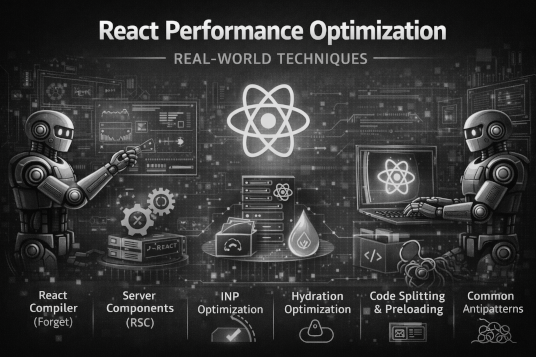
React Performance Optimization: Real-World Techniques
Practical performance optimization techniques for React applications. From rendering optimization to code splitting, learn what actually matters.
In 2026, React performance conversations have finally matured. We no longer obsess over virtual DOM diffing algorithms or micro-manage every re-render. We no longer reflexively wrap every callback in `useCallback` or debate whether `React.memo` should be applied to every component. Those concerns belonged to an earlier phase of React’s evolution.
Today, performance bottlenecks in real production systems are shaped by entirely different constraints. The stabilization of the React Compiler (Forget) has automated most memoization concerns. React Server Components (RSC) have dramatically reduced client-side JavaScript bloat. And web performance metrics have shifted from simplistic load-time measurements to holistic interaction metrics such as Interaction to Next Paint (INP).
The bottleneck is no longer the virtual DOM. It is the main thread. It is network waterfalls. It is hydration cost. It is the cumulative effect of JavaScript execution blocking user interaction.
Modern React performance engineering is less about clever hooks and more about architectural restraint.
1. The Death of Manual Memoization: Embracing the Compiler
For nearly a decade, React performance advice revolved around memoization. Senior engineers taught juniors to guard against unnecessary re-renders. `useMemo` and `useCallback` became ritualistic incantations applied preemptively rather than diagnostically. In many codebases, memoization logic became harder to reason about than the rendering problems it attempted to solve.
This era has largely ended.
The React Compiler (Forget) v1.0
With the production stabilization of the React Compiler, automatic memoization is now table stakes. The compiler analyzes component purity and dependency graphs at build time, transforming code to avoid redundant recalculations and unstable references.
For the majority of components, this eliminates the need for manual `memo()` wrapping. The compiler understands state and props relationships in a way that is both more precise and less error-prone than ad-hoc developer heuristics.
However, this does not mean performance is “solved.” It means the layer at which performance work happens has shifted.
When Manual Tuning Still Matters
The compiler cannot fix architectural anti-patterns. If a component performs heavy data transformations directly in its render body, the compiler may memoize the result—but the initial render cost remains. That first “cold” computation still blocks the main thread.
More critically, the compiler does not solve context-driven re-render storms. A single monolithic context provider that updates frequently will still invalidate large portions of the component tree. In 2026, performance-conscious teams address this structurally:
* Splitting context by responsibility
* Moving frequently changing state into atomic stores (Signals, Jotai, Zustand)
* Reducing global reactivity surfaces
Memoization is now automated. State architecture is not.
2. Server Components: Not Just for SEO
When React Server Components were introduced, many engineers dismissed them as primarily beneficial for SEO or static content rendering. In practice, RSC has become one of the most significant performance levers in large-scale applications.
The fundamental advantage of RSC is not search indexing. It is eliminating unnecessary client-side JavaScript.
Eliminating the "JS Tax"
In traditional client-side rendering, every piece of logic required to render a view must ship to the browser. This includes utility libraries, formatting logic, Markdown parsers, date manipulation tools, and animation frameworks. Over time, this leads to ballooning bundle sizes.
With RSC, logic executes on the server. Only the minimal representation of the component tree is serialized to the client. Heavy libraries remain server-side, reducing entry bundle weight dramatically.
In real-world enterprise dashboards, migrating even a few large feature modules to RSC can reduce initial JavaScript payloads by hundreds of kilobytes. That reduction directly impacts parse time, execution time, and hydration cost.
Killing the Network Waterfall
Perhaps more importantly, RSC collapses the classic client-side data-fetch waterfall. In CSR models, components mount, fetch data, then render children that fetch their own data. This leads to serialized network chains.
In an RSC architecture, data fetching occurs on the server—often in close proximity to the database. Multiple fetches can occur in parallel, and the resulting HTML can stream progressively. This shifts latency from the client’s main thread to the server’s controlled environment.
The result is not just faster load times—it is reduced client complexity.
3. Optimizing for INP: The New King of Metrics
When Google replaced First Input Delay (FID) with Interaction to Next Paint (INP), the performance landscape changed. FID measured only the first interaction. INP measures responsiveness across the entire lifecycle of a page.
This shift exposed a harsh reality: many applications felt responsive initially but degraded under sustained interaction.
The Long Task Problem
React remains synchronous by default. A large state update that triggers deep reconciliation can block the main thread for tens or even hundreds of milliseconds. During this time, the browser cannot respond to user input.
In low-complexity apps, this cost is negligible. In enterprise dashboards with dynamic filtering, charts, and rich UI states, these long tasks become common.
The solution is not eliminating state updates—it is prioritizing them.
Transitions and Yielding
Concurrent React features allow us to yield control back to the browser during non-urgent updates.
`useTransition` is arguably the most important performance primitive in modern React. By marking certain updates as non-urgent, you allow React to interrupt them if a higher-priority interaction occurs.
For example:
* Filtering a large list can be wrapped in a transition.
* Navigating to a heavy view can be marked as interruptible.
The user experience improves not because the computation is faster, but because it is interruptible.
`useActionState` further refines mutation handling, preventing form submissions or heavy state transitions from blocking interactive rendering.
Performance in 2026 is about responsiveness under load, not raw render speed.
4. Hydration: The Hidden Latency Killer
Early server-side rendering promised faster perceived performance because content appeared quickly. However, developers learned that visible content does not equal interactive content.
Hydration—the process of attaching event listeners and making HTML interactive—can block the main thread significantly, especially on low-end mobile devices.
Selective Hydration and Suspense
Modern React allows selective hydration through Suspense boundaries. Instead of hydrating the entire page eagerly, React prioritizes critical regions.
Above-the-fold content hydrates first. Non-critical sections wait until idle time. If a user interacts with a not-yet-hydrated component, React can prioritize that subtree.
This dramatically improves real-world responsiveness.
Streaming SSR
Streaming HTML as it is generated reduces time to first contentful paint, particularly for users on slower networks. Combined with selective hydration, this transforms SSR from a cosmetic optimization into a structural performance strategy.
Hydration is no longer invisible plumbing. It is a first-class performance concern.
5. Modern Code Splitting: Beyond React.lazy
Route-based splitting is now baseline practice. However, modern performance optimization requires more granular control.
Speculative Preloading
Rather than preloading all potential routes, advanced systems preload based on intent signals. Intersection Observers detect when navigation links enter the viewport. Hover events trigger low-priority bundle fetches.
This balances readiness with bandwidth conservation.
Visibility-Based Splitting
Not all components on a route deserve equal loading priority. Rarely used admin panels, modal-heavy features, or advanced analytics sections should be dynamically imported—even if they live on primary routes.
The goal is minimizing initial execution cost, not just bundle size.
6. What Breaks in Real Systems: Common Antipatterns
Enterprise audits reveal recurring performance pitfalls:
* High-frequency external stores without throttling cause constant re-render pressure.
* Passing massive serialized objects from Server Components to Client Components creates blocking JSON parsing tasks.
* Excessive context layering increases reconciliation cost across the fiber tree.
Each of these issues is architectural, not syntactic. No amount of `useMemo` can compensate for structural inefficiency.
Conclusion
React performance in 2026 is an exercise in architectural judgment. The React Compiler handles most micro-optimizations automatically. Developers are free to focus on higher-level concerns: minimizing client JavaScript, prioritizing interaction responsiveness, structuring hydration boundaries, and managing execution cost.
A senior engineer’s responsibility is no longer counting renders. It is managing latency budgets, bundle weight, and execution priority.
If you reduce the amount of JavaScript the browser must execute and ensure the main thread remains available for the user, performance follows naturally.
In modern React systems, architecture—not hook gymnastics—determines success.
Engineering Team
The engineering team at Originsoft Consultancy brings together decades of combined experience in software architecture, AI/ML, and cloud-native development. We are passionate about sharing knowledge and helping developers build better software.