
Architectural Maturity in the Age of Autonomous Systems
A deep dive into how system design has evolved by 2026. Learn how to architect scalable, reliable systems for agentic workloads, data density, and operational efficiency.
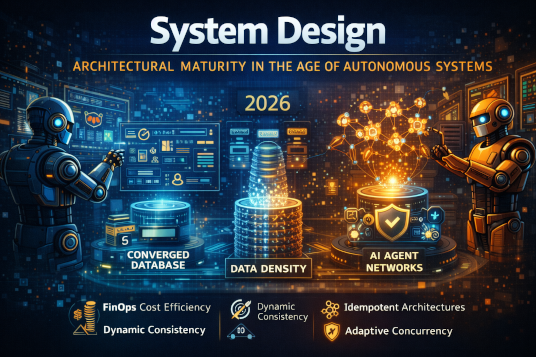
Designing Systems in the Agentic Era
Comprehensive guides on designing scalable, reliable, and maintainable systems. From databases to distributed architectures.
The discipline of system design has changed more in the past five years than in the previous fifteen. In the early 2020s, architectural discussions were dominated by questions of “web scale,” microservices migration, and horizontal sharding strategies. Engineering teams focused primarily on handling human-driven traffic—bursty, somewhat predictable, and constrained by natural user behavior.
By 2026, that mental model is no longer sufficient.
The defining characteristic of modern production systems is not just concurrency; it is Data Density and Agentic Workloads. Instead of millions of users clicking buttons at human speed, we now serve millions of autonomous agents that interact with APIs in recursive, sometimes unpredictable loops. These agents do not get tired. They retry aggressively. They parallelize. They explore alternate branches of execution. A single human request can now trigger a cascade of automated calls across dozens of services.
The challenge today is not simply scaling out; it is designing systems that remain understandable, operable, and cost-efficient under non-deterministic load. Senior engineers in 2026 are not optimizing for hype-driven distributed architectures. They are optimizing for cognitive load, operational resilience, and economic sustainability.
1. The Great Consolidation: Re-evaluating Service Boundaries
Teams often discover this the hard way: a distributed system composed of 200 microservices is rarely “scalable.” It is usually just a distributed monolith with higher latency and more failure modes. The early enthusiasm for microservices solved certain deployment and team autonomy challenges, but it also introduced enormous coordination overhead.
By 2026, the pendulum has swung toward consolidation. The Modular Monolith has regained respectability, and microservices are deployed with far greater restraint. The objective is no longer maximum decomposition, but maximum clarity.
From Nano-services to Domain Clusters
The era of “one service per database table” is widely regarded as a cautionary tale. Excessive granularity multiplies network hops, complicates transaction boundaries, and inflates operational cost. High-performing teams now favor Domain Clusters: cohesive groupings of related capabilities deployed together, often within a single process or tightly coupled service boundary.
Instead of fifty thin services, we see five or six robust modules representing well-defined business domains. Logical separation is enforced through clear interfaces, internal module contracts, and restricted database schemas, rather than physical process boundaries.
Logical vs. Physical Separation
In 2026, logical separation is prioritized over physical separation. Modules may share a database instance, but access is partitioned by schema or ownership conventions. Strict interface layers prevent cross-domain leakage.
This design yields a significant advantage: in-process communication. Eliminating internal HTTP calls removes the 10–50ms serialization tax per hop. In agentic workflows where a single request may trigger dozens of internal lookups, these savings compound dramatically. Milliseconds become user-visible latency and directly affect timeout rates.
The lesson is simple: distribution should be earned, not assumed.
2. Agentic Architecture: Designing for Non-Deterministic Load
The most profound architectural shift in 2026 is the rise of multi-agent orchestration. We are no longer serving just browsers and mobile apps; we are serving structured outputs to specialized agents capable of recursive reasoning and autonomous retries.
The “Microservices Moment” for AI
Much like we once decomposed monoliths into services, we are now decomposing large LLM workflows into specialized agents. A modern request might pass through an orchestrator—sometimes called a “Puppeteer”—that delegates subtasks to a Researcher agent, a Coder agent, and an Analyst agent. Each agent may call your APIs multiple times before producing a result.
This shift introduces new load patterns. Traffic is no longer human-paced. It is speculative and exploratory.
Idempotency and Agentic Loops
Agents retry aggressively. If an output does not satisfy internal validation, they often call endpoints repeatedly. At small scale, this behavior appears harmless. At scale, it becomes dangerous.
State-changing APIs must support idempotency keys as a first-class concept. Without them, retries create duplicate writes, inconsistent state, and financial or operational errors. In 2026, idempotency is no longer a “nice-to-have.” It is mandatory for any endpoint that mutates state.
Protocol Standardization (MCP)
The Model Context Protocol (MCP) has emerged as a standard for agent interaction. Instead of bespoke JSON schemas, MCP formalizes how agents discover tools, describe capabilities, and invoke structured actions.
If your system is not agent-discoverable, it increasingly becomes legacy infrastructure. The future is not just API-first—it is agent-first.
3. Data Management: Beyond the Static Aggregate
For years, Domain-Driven Design emphasized static aggregates as compile-time consistency boundaries. This model works well when business invariants are stable and predictable. However, modern systems must handle fluid, cross-cutting requirements.
Dynamic Consistency Boundaries (DCB)
Teams are increasingly experimenting with Dynamic Consistency Boundaries (DCB). Instead of hard-coding which entities belong to a transaction scope, systems tag events with contextual identifiers—studentId, courseId, facultyId, for example. At transaction time, the system assembles the necessary consistency boundary dynamically.
This approach reduces rigid coupling and allows invariants to evolve without schema rewrites.
The Post-Saga Era
The Saga Pattern served as a workaround for the absence of distributed transactions. However, Sagas introduce complex compensating actions and edge cases. Over time, teams realized that managing compensating transactions across dozens of services becomes a cognitive burden.
By consolidating domain clusters and leveraging dynamic boundaries, many systems reduce reliance on cross-service Sagas altogether. The focus shifts from compensating for fragmentation to preventing unnecessary fragmentation.
Postgres as the Converged Database
The multi-database sprawl of the mid-2020s is receding. Postgres, augmented with JSONB indexing and pgvector for vector search, has become a converged data platform. Rather than maintaining separate systems for relational data, document storage, and vector embeddings, teams increasingly consolidate into a single operational database.
This reduces operational complexity and aligns with the broader consolidation trend.
4. Reliability: Designing for Failure as the Default
Distributed systems have always assumed failure. What has changed in 2026 is the nature of failure. Services are not simply “down.” They may be partially correct, inconsistently slow, or returning subtly flawed AI-generated outputs.
Causal Tracing and eBPF
Traditional logs and metrics are insufficient for diagnosing complex, cross-service behavior. Causal tracing—tracking the propagation of requests across services—has become essential.
The industry has largely abandoned heavy sidecar-based service meshes in favor of eBPF-native networking layers. Kernel-level observability and enforcement reduce latency overhead while providing deep visibility into network behavior without introducing additional proxies.
Cascading Failure Mitigation
Retries remain one of the most common self-inflicted outages. Global retries amplify load under stress, creating distributed denial-of-service conditions.
Adaptive concurrency limits are now standard practice. Instead of fixed thread pools, systems monitor latency and dynamically reduce concurrency under degradation. Low-priority traffic—such as background agent workloads—is throttled first, preserving availability for high-priority user requests.
Resilience is no longer about redundancy alone; it is about intelligent load shaping.
5. FinOps: Cost as an Architectural Constraint
In 2026, cost is no longer a quarterly report. It is an architectural constraint. Token consumption, GPU usage, and cross-region egress directly influence system design decisions.
Token and GPU Egress Efficiency
For LLM-driven systems, token efficiency may outweigh CPU utilization as a performance metric. Architectures that indiscriminately invoke large models for every subtask quickly become economically unsustainable.
Pattern-level optimization—such as Plan-and-Execute workflows where smaller models perform planning and larger models execute only complex reasoning—can dramatically reduce cost without sacrificing quality.
The Carbon Receipt
Environmental considerations are increasingly integrated into system design. Some regulatory environments now require carbon reporting for infrastructure workloads. Green scheduling strategies shift batch jobs to periods of lower carbon intensity or regions powered by renewable energy.
FinOps is not about austerity. It is about aligning architecture with economic and environmental realities.
Conclusion: The Engineering Mindset
System design in 2026 demands restraint as much as ambition. Scaling horizontally is no longer the default answer. Consolidation, clarity, and cost-awareness often produce better outcomes than maximal distribution.
The value of a senior engineer lies not in assembling the most fashionable architecture, but in identifying the hidden failure mode that will manifest under stress. The ability to foresee how agentic retries interact with idempotency, how serialization tax compounds across service boundaries, or how token usage balloons under recursive workflows distinguishes durable systems from brittle ones.
There is no perfect architecture. There are only trade-offs. The craft of system design lies in choosing constraints deliberately—and ensuring you can sleep when those constraints are tested at 2:00 AM on a Friday.
Engineering Team
The engineering team at Originsoft Consultancy brings together decades of combined experience in software architecture, AI/ML, and cloud-native development. We are passionate about sharing knowledge and helping developers build better software.