
The Shape of Fairness: Why the World Should Look More Like a Narrow Bell Curve
A statistics-flavored argument for bounded inequality: why extreme wealth outliers signal an unstable system, and why a narrower distribution can mean a healthier society.
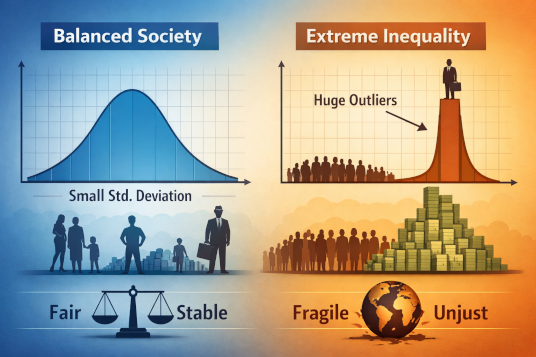
Standard Deviation and the Shape of Justice
In statistics, the standard deviation is a deceptively simple measure. It does not pass judgment. It does not prescribe values. It merely quantifies dispersion — the degree to which data points drift from the mean. It is a quiet instrument of measurement, indifferent to ideology. Yet when we move from abstract datasets to the lived realities of human societies, this modest concept becomes something far more provocative.
Standard deviation, in human contexts, becomes a mirror.
Imagine plotting the financial conditions of every person on Earth — income, wealth, asset ownership, access to opportunity. If the system were healthy in a structural sense, we might expect a distribution resembling a normal curve. Most individuals clustered around a central mean, some moderately above, some moderately below. Variation would exist, as it must in any dynamic society. But the differences would remain within an intelligible human scale.
In such a distribution, the standard deviation would be meaningful but bounded. Not zero — because equality of outcome is neither natural nor necessarily desirable — but moderate. Variation would signal diversity, not distortion. The tails of the curve would taper gradually, reflecting exceptional achievement or unfortunate circumstance without redefining the entire structure.
That is not the curve we observe today.
When the Curve Breaks
Modern global wealth distribution does not resemble a bell curve. It resembles a long-tailed distribution, with extreme skewness that stretches the right-hand tail far beyond intuitive scale. A small cluster of individuals exists so far from the median that their values compress the meaningful resolution of the rest of the dataset.
From a statistical standpoint, such outliers would demand scrutiny. In most analytical contexts, extreme points prompt investigation:
* Was there measurement error?
* Is the sampling biased?
* Is the process generating the data unstable?
* Does the model assume conditions that no longer hold?
In engineering, extreme deviations signal stress fractures. In finance, they indicate volatility risk. In machine learning, they can cause model overfitting, where a handful of extreme values dominate the objective function.
Yet in social and economic systems, we often normalize these outliers. We describe them as inevitable or as the natural consequence of merit. But normalization does not resolve structural imbalance. It merely adapts perception to reality.
When a single individual’s wealth rivals that of entire populations, the deviation is no longer anecdotal. It is systemic.
Why Zero Deviation Is Neither Possible nor Desirable
It is important to resist the simplistic counterargument that the only alternative is perfect equality. A world in which every person holds identical wealth — a standard deviation of zero — would be static and arguably unjust in its own way. Human beings differ in creativity, discipline, risk appetite, timing, collaboration, and luck. Variation is a feature of dynamic systems, not a flaw.
Justice does not require sameness. It requires proportionality.
The philosophical insight lies not in eliminating deviation, but in bounding it. A healthy system allows for exceptional success without permitting extreme dominance to distort the scale of comparison. In statistical terms, the goal is not to collapse the distribution into a single value, but to prevent the tails from stretching infinitely.
No data point — no individual — should be so extreme that it alters the interpretability of the entire distribution.
When variance becomes unbounded, scale itself loses meaning.
Outliers Carrying the Weight of the World
There is something inherently unstable about distributions where the “mass” concentrates disproportionately at the extremes. In physics, if weight accumulates at a structural edge, stress fractures propagate inward. In economics, extreme wealth concentration can produce analogous instability:
* Aggregate demand weakens because purchasing power clusters among those least likely to spend proportionally.
* Social mobility declines as opportunity becomes inherited rather than generated.
* Institutional trust erodes when outcomes appear statistically implausible for the median participant.
When the wealth of a few outliers exceeds that of billions combined, the system no longer resembles a bell curve. It begins to resemble a power law with runaway scaling.
Power-law distributions exist naturally in some systems — for example, network connectivity or word frequency in language. But in engineered systems, we often apply constraints to prevent runaway concentration. We regulate monopolies. We diversify portfolios. We enforce risk caps.
The absence of constraint in wealth distribution is not neutrality. It is a design choice.
Equilibrium as a Statistical, Not Ideological, Goal
The argument here is not ideological uniformity. It is systemic stability.
Engineers design bridges with tolerance ranges. Financial analysts diversify portfolios to minimize variance. Machine learning practitioners apply regularization to prevent models from being dominated by extreme weights. Across disciplines, we recognize that unbounded variance creates fragility.
Yet when discussing wealth distribution, variance is often treated as sacrosanct — immune to structural consideration.
A narrower bell curve does not imply mediocrity. It implies equilibrium. It allows excellence without allowing scale to become infinite. It permits accumulation without converting it into permanent asymmetry of influence.
Equilibrium is not stagnation. It is resilience.
Reading the Data, Hearing the Message
Statistics cannot dictate morality. But it can reveal imbalance.
If today’s global wealth distribution were presented as an unfamiliar dataset in a technical context, we would likely flag it as unstable. We would note extreme skewness. We would calculate a high Gini coefficient. We would examine tail risk. We would question the long-term sustainability of such dispersion.
We would not call it optimal.
We would call it fragile.
Justice, in statistical terms, is not equality of outcome. It is equilibrium of scale. A society can tolerate difference, even large difference, so long as no single data point overwhelms the dataset.
And perhaps the most unsettling implication is this:
If we encountered the current wealth distribution without historical or emotional context — purely as data — we would not defend it.
We would attempt to redesign the model.
Engineering Team
The engineering team at Originsoft Consultancy brings together decades of combined experience in software architecture, AI/ML, and cloud-native development. We are passionate about sharing knowledge and helping developers build better software.